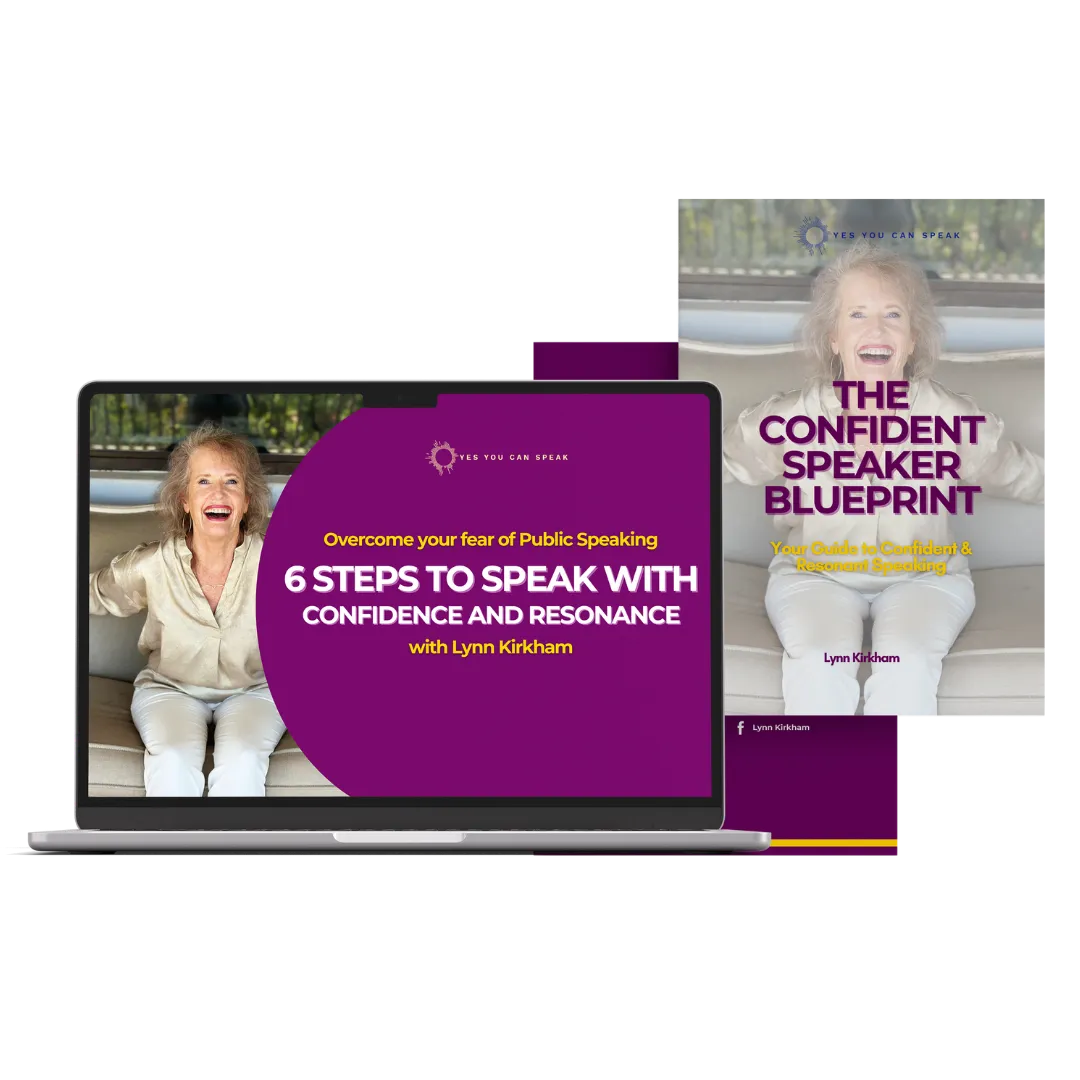

Why Smart People Wait Years to Fix Speaking Fear
For years, I paid people to speak on my behalf.
I'm serious. I'd hire someone to make the introduction and deliver the pitch, and I built an entire professional life around being the person who ran things from the side of the room instead of the front of it. I was good at it, too, which made it very easy to keep doing.
I was a wallflower with a business card and a workaround for every situation.
Nobody in my life would have described me as someone with a problem. That's the thing about this particular fear, it's underneath competence. You're producing and delivering and getting promoted, and the whole time you're routing around a thing you've decided you'll deal with later.
Later has a way of taking about fifteen years.
If any of this sounds familiar, the free speaking pattern quiz is a good place to start. It takes about three minutes and it names what's been sitting underneath all those workarounds.
Why Can't I Get Over My Fear of Public Speaking?
Because the fear lives in your nervous system, which doesn't much care what you know about it. Understanding it perfectly and freezing anyway is the most common experience there is.
When you ask yourself "Why can't I get over my fear of public speaking?" the answer typically has a lot of self-blame attached to it.
You've read about it and likely understand the physiology, the evolutionary logic and tried every breathing technique that was supposed to help.
And you still freeze.
That gap between what you know and what your body does can be so frustrating. Your nervous system learned something, probably a long time ago, about what happens when you're seen and heard, and it's been running that protection mechanism ever since. Unfortunately, it doesn't take instructions from the part of you that reads articles.
So you've been applying thinking-brain solutions to a body-level pattern, which was never going to get you there no matter how rigorously you did it.
When I was in the printing industry, I remember spending hours memorizing what I wanted to say to a potential new client. I had it down pat, walked into her office and her boss and one of his peers was joined us. For me my threshold was two people. There were three and my body decided to make my teeth chatter. During all the commotion I couldn't remember a thing I had memorized. Needless to say, the meeting was short and I didn't get the account.
What Are the Excuses That Keep This on the Shelf?
The most common ones are waiting for a calmer quarter, assuming the next role will fix it, and deciding you're simply not a speaker.
I've heard these hundreds of times, often from people who are otherwise ruthless about spotting their own blind spots.
"I'll deal with it when things settle down." Things don't settle down, or at least I've never watched it happen. You've said this every quarter for six years and each quarter has been the busiest one yet, and meanwhile the meetings keep happening.
"Once I get the promotion, I'll have more confidence." This one runs backward. The speaking is what gets you the promotion, and the higher role comes with more visibility instead of less. VPs speak constantly and founders pitch every week. Exposure goes up with seniority, pretty much without exception.
"I'm just an introvert." Introversion is about where your energy comes from and speaking fear is about threat response, and the two get conflated constantly. Introverts speak beautifully about as often as extroverts freeze.
"I've tried everything, so it must be permanent." You've tried the technique approaches, which means Toastmasters and coaches and books and apps. That's one category of intervention, thoroughly explored, and it's a long way from everything that's available.
"It's not that bad." This is the most expensive one, and it's usually the last defense standing before someone books a call.
What Does the Waiting Actually Cost?
Avoidance compounds. Each declined opportunity narrows the next set of options, and the pattern reinforces itself with every workaround you build.
Vague costs are easy to dismiss, so here are the specific ones.
Start with the visible losses. The keynote you declined. The panel you handed to a colleague. The client meeting where someone more junior presented your work. The job you didn't apply for because of the presentation round. Each of those is a specific fork in a career and you know exactly which ones yours were. If you want the fuller picture of what this adds up to, the career return on this work tends to surprise people.
Then the invisible ones. The idea you had in week two that someone else voiced in week five, to considerable enthusiasm. The team that never quite gelled because they couldn't feel your conviction. The reputation for being thorough instead of for being a leader, which follows you into every calibration conversation.
The physical toll is the part almost nobody counts. The hours of dread before a fifteen-minute update, the sleep lost the night before, the three days of replaying it afterward. Add that up across a decade and it's an enormous amount of your one life spent in a stress response over something that could have been handled.
And then it compounds. Every avoided situation teaches your nervous system that avoidance worked, which strengthens the pattern for the next time, so it doesn't hold steady over the years. It quietly deepens.
None of this is meant to make you feel worse. You already know all of it, which is exactly why you've been keeping the door shut.
What Changes When You Finally Deal With It?
People consistently report that the career effects arrive faster than they expected, and that the quieter internal shift ends up mattering more to them.
The professional changes are the ones people expect. Speaking up in meetings without rehearsing first, presenting without the three-day recovery, being seen as a leader by people who used to see a competent specialist. Those things happen, and they tend to happen sooner than most people expect.
But when I ask people a year later what changed most, they rarely lead with the career part.
They talk about not dreading Tuesdays, and about being able to enjoy dinner the night before instead of running scenarios in their head. About a wedding toast they gave without terror, or reading to their kid's class without their hands shaking.
One client put it this way: she got a piece of her life back that she hadn't noticed she'd handed over.
That's what waiting has been costing you. Career advancement comes too, and mostly it's a general lowering of the volume on something that's been humming in the background for most of your adult life.
How Do You Know When It's Time?
When you've started turning down things you actually want, and when you've been saying "next year" for more than two years. Dread that outlasts the event itself is another good sign.
If you're looking for permission, here it is. You don't need to be in crisis or have a specific talk on the calendar to justify working on this. The bar is just that something you want is on the other side of speaking, and you've been going around it.
That's enough of a reason. If you want to see what someone who decided to stop waiting actually looks like, read what Janet Kim did about it.
Three Doors, Depending on Where You Are
If you're not sure what's actually going on for you, take the speaking pattern quiz. Three minutes, and it'll tell you whether you're an Over-Preparer, a Rusher, One Who Holds Back, or running an Inner Critic. Naming the pattern you're running is a real first step.
If you want to test the approach before committing, come to the free virtual ninety-minute workshop on Thursday, September 17th 01:00 PM – 02:30 PM PT. Nobody gets called on, cameras are optional, and you'll leave with one practice you can use immediately.
If you're ready to do the work properly, the Fall cohort of Speak and Lead Like a Pro opens now.
Online: Saturdays, October 3, 10, 17, from 10:00 am to 2:30 pm PT
In person, Bay Area: Sundays, October 4, 11, 18, from 1:00 pm to 6:00 pm in Los Gatos or San Jose
Six weeks, live and interactive, with a group of people who understand exactly why you're there. See the full program. For private work, CORE Repatterning™ sessions run year-round by appointment.
Frequently Asked Questions
Is fear of public speaking something you can actually cure? Most people don't get all the way to zero nervousness, and they do get to a place where it stops driving their choices. That's the outcome worth aiming for.
Is public speaking coaching worth the investment? It depends almost entirely on the approach. Technique coaching works well for people who are already regulated, and if your fear is body-level you'll want work that goes at the nervous system directly.
Can I fix this on my own? Some people do make progress alone with consistent somatic practice. Most do better with someone tracking the pattern alongside them, because the parts you can't see are usually the parts holding it in place.
Does speaking fear get worse with age? It tends to deepen with avoidance rather than with age. Every situation you route around strengthens the pattern, which is why decades of workarounds make it feel more fixed than it actually is.
I've already tried Toastmasters and coaching. What's different here? Both are repetition and technique models, and both assume your thinking brain is available to you under pressure. Nervous system work starts earlier in the chain, before the point where those approaches lose access.
One Last Thing
I spent fifteen years paying other people to use their voices because I'd decided mine wasn't going to cooperate.
Nobody made me deal with it. There was no crisis and no ultimatum. I just got tired of the workarounds, which is a perfectly good reason.
If you're tired of yours, book a free 15-minute Speaker Breakthrough Call. Fifteen minutes, no pitch, just a conversation about where you are and what would help.
Your voice has been waiting a long time.